Why Your Mechanic Bill Is So High: 4 Secrets About Car Servicing in South Africa
1.0 Introduction: The Shock of the Bill
We’ve all been there. You drop your car off for what seems like a quick fix, and when you return, the bill is shockingly high. It’s a moment of confusion and frustration familiar to most drivers. Consider the experience of Mike, a car owner who took his vehicle to a dealership for a squeaky belt idler. The technician fixed it in 20 minutes, yet the bill charged him for 1.5 hours of labour. This scenario isn’t an anomaly; it’s a glimpse into the standard operating procedures of the auto repair industry.
This article pulls back the curtain on the hidden economics and rules that govern your car service bill. By understanding these four industry truths, you can move from being a confused consumer to an empowered and informed vehicle owner.
2.0 Takeaway 1: Deconstructing the Labour Rate
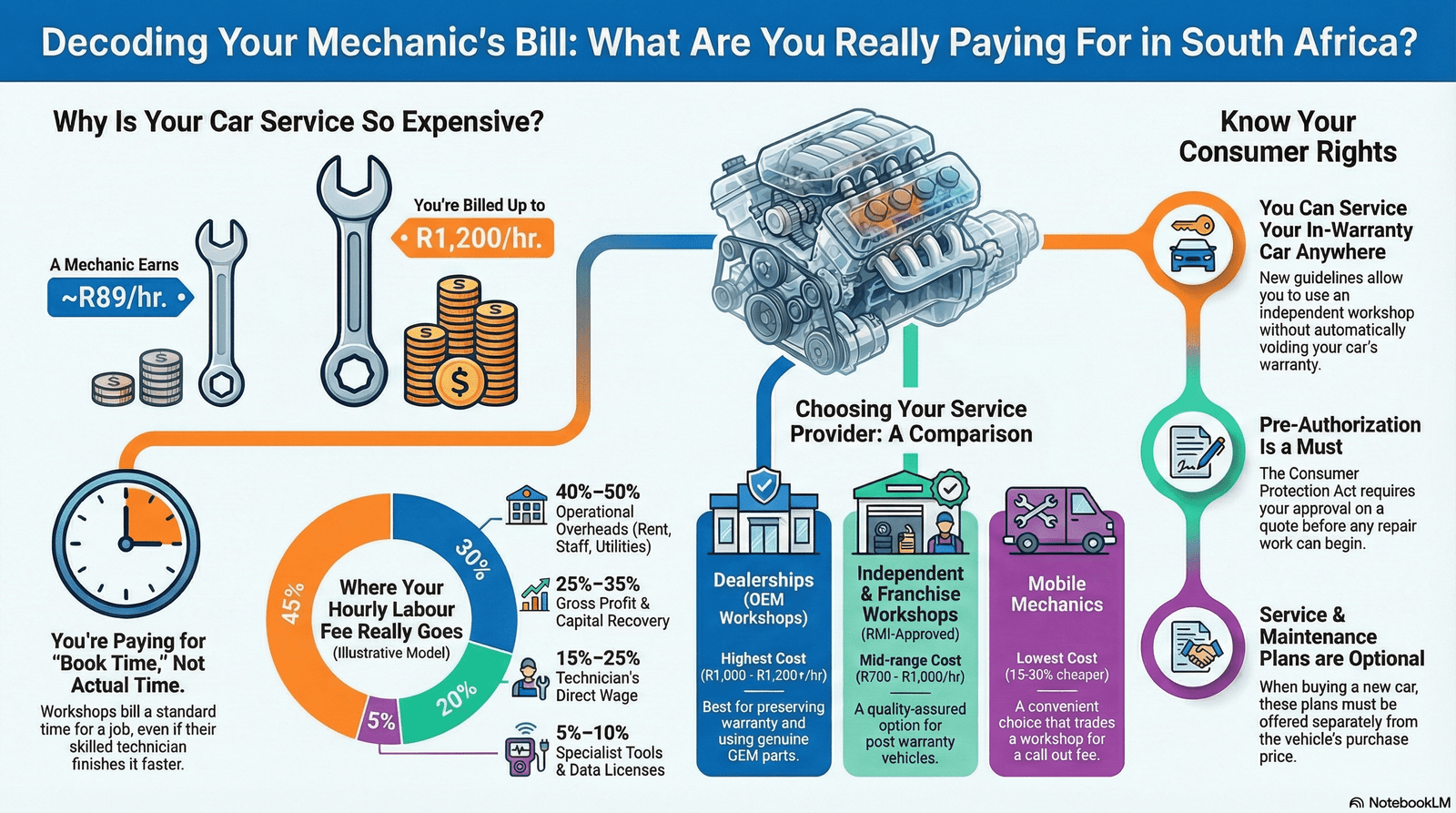
When you see a dealership labour rate of R1,000 to R1,200 per hour on your invoice, it’s natural to assume the mechanic is earning a fortune. The surprising truth is that the technician’s direct wage is only a small fraction of that cost—typically around 15% to 25%.
The majority of that high hourly rate is dedicated to “overhead recovery.” It covers the substantial operational costs of running a modern workshop: high rent, expensive specialized tools and diagnostic equipment, administrative staff wages, insurance, and utilities. A single repair job involves more than just the mechanic who turns the wrench. As industry veteran Mark Salem points out, the process is far more complex than it appears from the waiting room.
“You had 4 people involved in the repair of your car (serv writer, tech, shop foreman and cashier) not just one for 20 minutes.”
3.0 Takeaway 2: Billing by the Book, Not the Clock
This brings us back to Mike’s story: how can a 20-minute job be billed as 1.5 hours? The answer lies in a universal industry practice known as “book time,” “flat rate,” or “Sold Time.”
Workshops use sophisticated estimating software, like Audatex, which provides a standardized time for nearly every conceivable repair job. This is the time an average technician using standard tools should take. Whether the workshop’s highly experienced mechanic finishes the job in a fraction of that time or a less experienced one takes longer, you are billed for the “book time.”
This system serves two main purposes. First, it creates pricing consistency, allowing workshops to provide accurate quotes upfront. Second, it rewards efficiency. Experienced technicians who consistently “beat the book” are highly valued; in fact, an efficient technician is expected to have an “Efficiency” rating of over 100%, meaning they regularly complete jobs faster than the standard time. While this can sometimes feel unfair to the customer, it also protects you from being charged extra for a job that unexpectedly takes longer than planned. As Mark Salem explains, it’s the most balanced system available.
“If it weren’t for ‘the labor book’ what would we do, how would we bid work? The labor book tells everyone how much time an average tech can do a job using normal tools… 60% of the time it favors the customer and 40% of the time it favors the shop and that is the best of all the other options available to us today.”
4.0 Takeaway 3: The Loyalty Strategy
It might seem counter-intuitive, but servicing your new car at a dealership can sometimes be cheaper for the first few years than at an independent workshop. This isn’t a simple act of goodwill; it’s a calculated business strategy.
Manufacturers often subsidize the cost of these initial services to achieve a critical goal: keeping you, the customer, within their network. By offering attractively priced services while your car is new, they build loyalty and establish a habit. The long-term objective is to ensure you continue returning to them for more significant maintenance and repairs once your vehicle is out of its service plan or warranty period. It is during this phase that the dealership can charge higher margins, making their initial investment in you pay off.
5.0 Takeaway 4: Your Right to Choose
This is a game-changer for South African car owners. The “Guidelines for Competition in the South African Automotive Aftermarket,” which became effective on July 1, 2021, have fundamentally shifted the power back to the consumer.
Under these guidelines, you now have the legal right to use an Independent Service Provider (ISP)—that is, a non-dealership workshop—for services and repairs while your car is still under its original warranty.
Crucially, using an ISP does not automatically void the entire manufacturer’s warranty. If a specific part fails due to faulty workmanship or a non-original part fitted by an ISP, the manufacturer may void that specific part of the warranty. However, the rest of your car’s warranty remains fully intact. The guidelines also level the playing field by mandating that Original Equipment Manufacturers (OEMs) must make original parts and essential technical information available for sale to independent workshops.
6.0 Conclusion: Knowledge is Horsepower
Understanding the structure behind your car repair bill—from the illusion of the hourly rate and the reality of “book time” to dealership strategies and your new “Right to Repair”—transforms you from a passive consumer into an informed one. This knowledge doesn’t just demystify the process; it equips you to make smarter, more confident decisions about maintaining your vehicle.
Armed with this insight, how will you approach your next car service differently?
7.0 Frequently Asked Questions (FAQ)
What is “book time” and why do repair shops use it? “Book time” (also known as “flat rate” or “Sold Time”) is the standardized time allocated for a specific repair job, as determined by industry estimating guides and software like Audatex. Workshops use it to provide consistent quotes and bill customers for a standard duration, regardless of how quickly their specific technician actually completes the work. This system rewards efficient mechanics and protects customers from being overcharged if a job takes longer than expected.
Is it legal to service my new car at an independent workshop while it’s still under warranty in South Africa? Yes. As of July 1, 2021, the “Guidelines for Competition in the South African Automotive Aftermarket” give consumers the right to use an Independent Service Provider (ISP) for services and repairs on vehicles that are still under the manufacturer’s warranty.
What happens to my warranty if an independent mechanic causes damage? Using an independent mechanic does not automatically void your entire warranty. However, if a vehicle failure is caused by the work done or a part fitted by an independent provider, the manufacturer may void that specific part of the warranty. The rest of the warranty on unrelated components remains valid.
What is the RMI, and why should I look for an RMI-approved workshop? RMI stands for the Retail Motor Industry Organisation. It is a body that certifies automotive businesses that meet strict industry standards for quality workmanship, fair pricing, and ethical service. Choosing an RMI-approved workshop provides a layer of quality assurance and gives you access to a formal dispute resolution process if issues arise. Many motor warranty providers require repairs to be done at RMI-approved facilities.
What are my rights regarding repair estimates under the Consumer Protection Act (CPA)? Under Section 15 of the CPA, a service provider must give you an estimate and get your authorization before beginning any repair work. They cannot charge you more than the estimated price unless you are informed of the additional charges and you approve the continuation of the work.
Can a workshop charge me just to give me a quote? Yes, a workshop can charge for preparing an estimate, especially if it involves diagnostic work, disassembly, or re-assembly. However, under the CPA, they must first disclose the price for preparing the estimate and get your approval before proceeding.
What is the real cost difference between a dealership and an independent mechanic? Franchise dealerships are generally the most expensive option, often charging 20-40% more than independent workshops. Dealership hourly labour rates can range from R1,000 to R1,200 or more, while RMI-approved independent workshops are typically in the R700 to R1,000 range. Mobile mechanics can be 15-30% cheaper than fixed workshops due to lower overheads.
Can I supply my own parts to the workshop? Yes, you can. The customer in the “Salem Boys Auto” case supplied his own idler pulley. However, be aware that the workshop makes a profit on parts sales, so they may be less flexible on labour charges if they miss out on the parts markup.
What is a diagnostic fee and when is it charged? A diagnostic fee is a charge for the time and specialized equipment used to accurately identify the cause of a vehicle’s problem. It typically ranges from R700 to R1,200. This fee is charged upfront to cover the cost of troubleshooting and is legally permissible under the CPA, provided the cost is disclosed and approved by you beforehand. The fee is often waived by dealerships if the subsequent repair is covered by a warranty or service plan.
8.0 Sources
• Book labor time versus actual time – Salem Boys Auto
• Car Diagnostic Inspection Near Me| We Come To You – Michanic
• Car service costs in South Africa: What to expect – Car Ownership – AutoTrader
• Collision Estimating Software – Create Your Best Estimates – Contact Us
• Consumer Protection Act: National Consumer Commission: South African Automotive Industry Code
• Dealer mechanic vs independent workshop. New car servicing. : r/Adelaide – Reddit
• GUIDELINES FOR COMPETITION IN THE SOUTH AFRICAN …
• Identify Problems with a Car Diagnostic Test
• RMI Approved Workshops: What You Need to Know – dotsure.co.za Insurance
• South African Automotive Aftermarket Pricing Dynamics: A Competitive Deep Dive and Financial Rate Calculation Analysis
• TIME, if not utilised, is gone forever! – Amatz Automotive
• What is a normal hourly rate for car mechanics? : r/askSouthAfrica – Reddit